

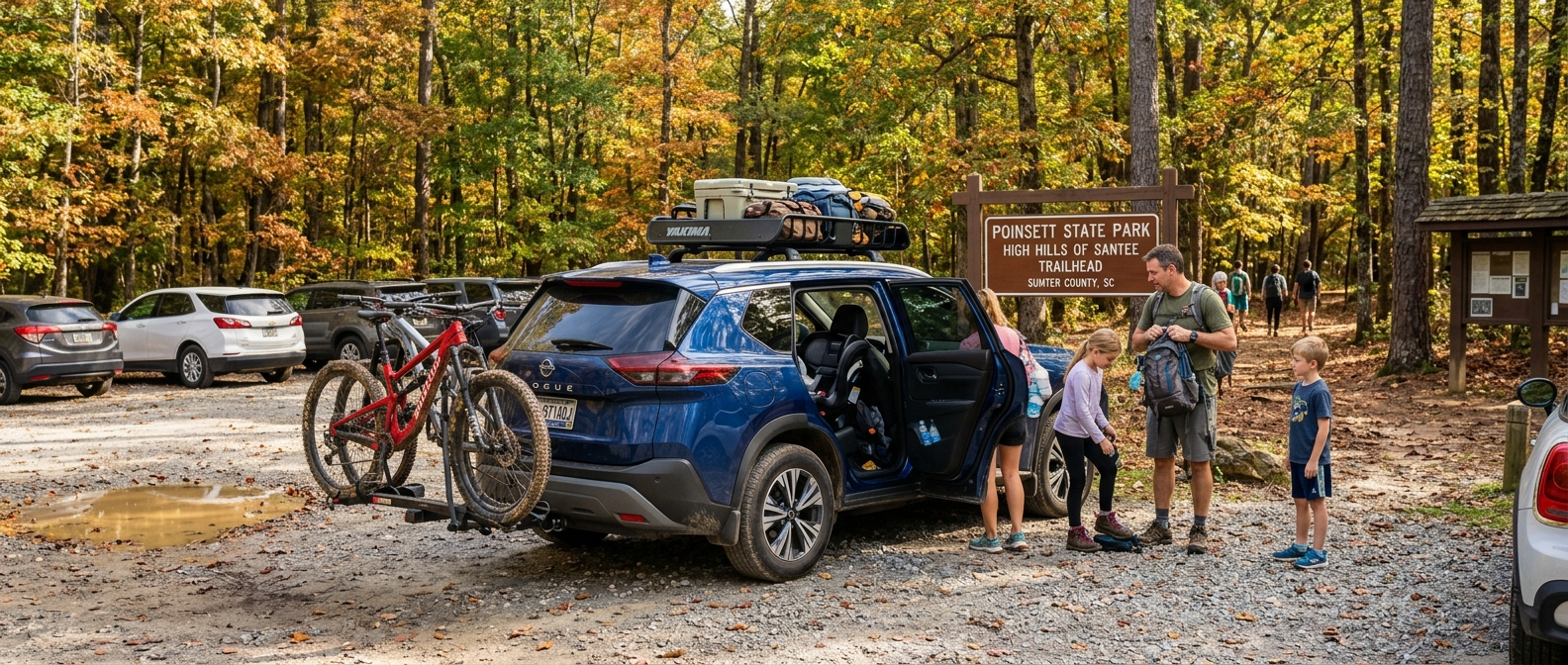
A practical guide to preparing a Nissan for fall road trips from Sumter. Learn which six service checks matter most before heading to Charleston, Poinsett State Park, or Columbia, from CVT fluid inspection and battery load testing through brake fluid condition, tire pressure and tread depth, cabin air filtration, and engine air filter evaluation. Sumter's summer heat and stop-and-go traffic qualify most vehicles for severe-driving maintenance intervals, compressing service windows and making pre-trip preparation essential to avoid roadside breakdowns.
Fall road-trip season from Sumter is here, and the routes are easy to love. Poinsett State Park sits 30 minutes west on US-76. Charleston is two hours down US-15. Columbia's a quick 45 minutes on US-378. None of those distances should intimidate anyone. What bites drivers is skipping the pre-trip service check after a summer that was genuinely hard on the vehicle.
So why does a summer here change the math? Sumter's heat, humidity, and stop-go commuter traffic (think the US-76/US-378 corridor at rush hour, or base traffic near Shaw) qualify most of our customers' vehicles for what Nissan calls "severe driving" conditions, and that classification compresses your service intervals. The CVT fluid in your Nissan Rogue has been working harder than the mileage number alone suggests. So have your brakes, your battery, and your cabin filter.
We rank these six checks by consequence. Miss the top ones and a breakdown on I-26 to Charleston becomes a real possibility. Miss the bottom ones and you're just uncomfortable. Either way, handle them now.
The Fall Road-Trip Service Ranking
| Rank | Service Item | Best-For | Standout Spec / Threshold |
|---|---|---|---|
| 1 | CVT fluid inspection | CVT-equipped models (Rogue, Altima, Sentra, Pathfinder, Murano, Kicks) | Severe-use interval: every 30,000 miles; fresh fluid is translucent pink or light green |
| 2 | Battery load test | All models, especially 3+ year-old vehicles | Lead-acid batteries lose measurable cranking capacity above 90 degrees F repeated exposure |
| 3 | Brake fluid condition | All models; critical for tow-rated Frontier and Armada | Brake fluid is hygroscopic; moisture absorption lowers its boiling point over time |
| 4 | Tire pressure and tread depth | All models | NHTSA minimum usable tread: 2/32 inch; tire pressure drops roughly 1 PSI per 10-degree temperature drop |
| 5 | Cabin air microfilter | All models | Nissan-recommended replacement: every 15,000 miles; one full SC pollen season clogs these fast |
| 6 | Engine air filter | All models, especially those driven on unpaved rural roads | Replace every 15,000 to 30,000 miles depending on conditions; dusty roads shorten the interval |
1. CVT Fluid: The Check Sumter Drivers Skip Most Often
Handle the CVT fluid first, because the reason is less about your odometer than about how the transmission has actually been living this summer, and Nissan's CVT (Continuously Variable Transmission) is standard across most of the lineup, including the Rogue, Altima, Sentra, Pathfinder, Murano, and Kicks. Under normal driving conditions, Nissan recommends inspecting and potentially changing the fluid at 60,000 miles. Under severe driving conditions, that window tightens to every 30,000 miles.
Sumter checks almost every severe-driving box. Stop-go traffic near the US-378/US-76 interchange. Repeated short trips to Shaw AFB and back. Hot weather sustained well into September. Nissan's own maintenance schedule flags stop-and-go driving in high ambient temperatures as severe use, and that accelerates fluid breakdown.
Fresh CVT fluid is translucent pink or light green. Dark brown or black means it's been cooking.
A fluid change at the right interval is straightforward and far cheaper than a CVT replacement, which is a repair no one wants to face on the road to Charleston.
Check our Altima inventory if you're running a higher-mileage CVT-equipped commuter and the conversation has shifted toward a replacement.
2. Battery Load Test: Heat Kills Batteries Quietly
Cold weather gets the blame for dead batteries, and that's fair, but the structural damage actually happens in the heat, so a battery load test earns the number-two spot before you ever point the car toward Charleston. A South Carolina summer full of 95-degree afternoons sitting in a parking lot accelerates internal plate corrosion and reduces the battery's ability to hold a charge. By the time temperatures drop into the 70s in October, you may be working with a battery that tests low under load even if it's been starting fine.
Our technicians run a load test, not just a voltage check. Voltage tells you whether the battery is alive, and a load test tells you whether it can still deliver cranking amps under demand. A failure on US-521 heading toward the Santee lakes is no fun to sort out. If your battery is three years old or more, get the test first.
3. Brake Fluid: The Humidity Problem No One Talks About
Brake fluid absorbs water from the air over time, and in a climate as humid as the Midlands that's a real concern rather than a theoretical one, which is why it earns the number-three spot even though nothing about it looks wrong from the driver's seat. The mechanism is quiet and gradual, so you won't see it coming.
Brake fluid is hygroscopic, which means it absorbs moisture from the air over time. The Midlands is not a dry climate.
The absorption is gradual and invisible, but its effect is real, lowering the fluid's effective boiling point, and that matters most during sustained highway braking or when a loaded vehicle is slowing from highway speed.
Nissan's schedule calls for brake fluid replacement every two years regardless of mileage. If your fluid has gone dark brown in the reservoir (it should look like light amber or pale yellow when healthy), that's visible contamination and it's ready to come out now.
Frontier and Armada owners planning to haul gear or a trailer on fall trips should treat this as a higher-priority item. More vehicle weight means the braking system generates more heat per stop, and degraded fluid has less margin to handle it.
Pros and Cons of a Full Pre-Trip Service Appointment vs. Individual Item Fixes
| Pros | Cons |
|---|---|
| Technician catches secondary issues you might miss individually (a worn belt alongside a battery, corroded terminals alongside brake fluid) | Takes more time than a single-item service |
| Single visit; your vehicle doesn't need to come back twice before the trip | You may pay for items you don't actually need yet |
| Nissan multi-point inspection is included at no additional charge | Scheduling a full appointment takes a few days' lead time |
| Peace of mind is worth something on a 300-mile round trip | None of the prep work is visible to anyone but you |
4. Tire Pressure and Tread: Two Separate Checks, Both Mandatory
Tire pressure and tread are two separate checks, and both are mandatory, because the TPMS light covers only one of them and plenty of drivers trust it to cover both. The system alerts you when pressure drops significantly, but it won't catch a tire that's technically inflated while still worn to marginal tread depth.
NHTSA's minimum usable tread depth is 2/32 of an inch. Check tread across multiple points on each tire, because tires don't always wear evenly front-to-back or side-to-side. The penny test works. Insert a penny into the tread groove with Lincoln's head down and facing you, and if you can see the top of Lincoln's head, you're at or below 2/32 and the tire is due for replacement.
On the pressure side, temperatures are dropping here in Sumter as we move through late September into October. Tire pressure drops roughly 1 PSI for every 10-degree Fahrenheit decrease in ambient temperature. A tire set at 35 PSI during August's 95-degree afternoons will read closer to 32 PSI on a 65-degree October morning. Check the door placard (not the tire sidewall) for the correct PSI, and set it cold in the garage before you leave, since an hour on hot pavement adds real PSI back.
5. Cabin Air Microfilter: Worse Than You Think After an SC Summer
Nissan recommends replacing the in-cabin microfilter every 15,000 miles, but here in the Midlands one full spring pollen season followed by a hot, humid summer can push that filter past its effective life well before the mileage number arrives. A clogged cabin filter restricts airflow through your HVAC system, which makes the blower work harder and leaves your defrost less effective. On a fall road trip through the SC Upstate where morning fog is real, a weak defroster is a genuine inconvenience.
The filter sits behind the glove box on most Nissan models. A technician swaps it in minutes.
The cabin filter isn't the most dramatic service item on this list. Still, it changes the cabin immediately in a way you'll actually notice on the drive.
6. Engine Air Filter: Check It If You've Been on Unpaved Roads
The engine air filter sits last on this list because it's the least likely item here to strand you, and when it does go it degrades gradually, showing up as reduced throttle response and slightly lower fuel economy rather than a sudden roadside stop. Nissan's guidance for the 2026 Pathfinder (and the broader lineup) calls for inspecting the engine air filter for contamination and replacing it on the specified schedule, with more frequent changes required under dusty conditions.
If you've spent the summer on gravel drives around Manchester State Forest, on unpaved roads near Lake Marion, or running errands on any of Sumter County's less-traveled rural routes, inspect the filter before assuming it's fine based on mileage alone. A dirty filter that's choking airflow into the engine is also dragging your fuel economy on that two-hour highway stretch to the coast.
Schedule your pre-trip service visit with our team and we'll run through every item on this list in a single appointment.
Schedule Your Fall Road-Trip Service
Get the Trip Right By Getting the Car Right First
The CVT fluid check is the most consequential item here for most Sumter drivers, full stop, because Sumter's summer conditions qualify as severe by Nissan's own definition, and that means most CVT-equipped vehicles sitting in our service bay in September are running on fluid that's been working hard since spring. Handle that one first. Then the battery, then the brake fluid.
The rest of the list (tires, cabin filter, engine air filter) is real and worth doing, though it's the comfort tier, and none of those three will strand you on the way home. All six together take one service appointment, a reasonable trade for a clear drive down to the Lowcountry or up to Poinsett State Park without anything unexpected interrupting the weekend. You might pay for a check that turns up nothing wrong. Fine.
Our service team is here and ready to get your Nissan road-trip ready before the fall calendar fills up.
By the Nissan of Sumter Team | September 2026